
That Frustrating Moment When Your Garage Door Won't Stay Closed
You press the button on your remote, watch your garage door begin its descent, and then — just before it reaches the floor — it stops and reverses back up. You try again. Same result. Maybe you try holding the wall button down, and it still won't cooperate.
This is one of the most common garage door complaints we hear from homeowners in Port Charlotte, and it's more than just an annoyance. A garage door that won't fully close leaves your home vulnerable to intruders, pests, rain, and Florida's relentless humidity. The good news is that this problem usually has a straightforward explanation, and in many cases, it can be resolved quickly.
Let's walk through the most likely reasons your garage door reverses before hitting the floor and what you can do about each one.
1. Misaligned or Dirty Safety Sensors
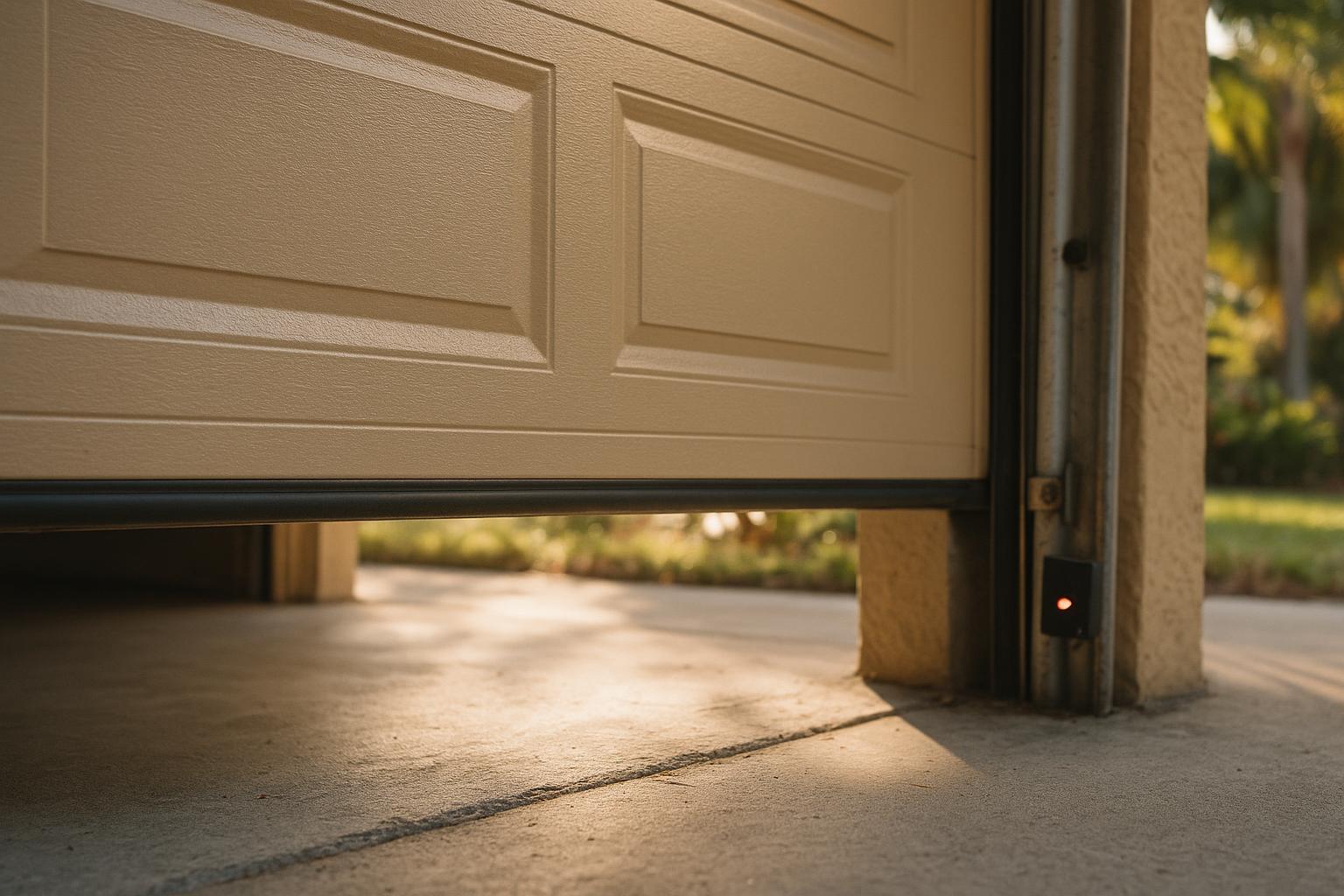
This is the number one cause of a garage door that reverses unexpectedly. Every modern garage door opener is equipped with two photoelectric safety sensors mounted near the bottom of the door tracks, one on each side. These sensors send an invisible beam across the opening. If anything breaks that beam — a bicycle, a trash can, a child, or even a cobweb — the opener interprets it as an obstruction and reverses the door.
Here's what to check:
- Alignment: Look at the small LED lights on each sensor. On most models, both lights should be steady (not blinking). If one is flickering, the sensors are likely out of alignment. Gently adjust the sensor until the light holds steady.
- Dirt and debris: Wipe the lens of each sensor with a soft, dry cloth. In Port Charlotte, pollen, dust, and moisture can build up quickly, especially during the humid summer months.
- Sunlight interference: Direct afternoon sun can sometimes overwhelm the sensor's infrared beam. If your garage faces west, this could be a seasonal issue. A small shade or cardboard tube around the sensor lens can help.
2. Incorrect Close-Limit Settings
Your garage door opener uses limit settings to determine how far the door should travel when opening and closing. If the close-limit setting is off, the opener may think the door has hit an obstacle when it's actually just reaching the floor. The opener's built-in safety feature then kicks in and reverses the door.
Adjusting limit settings typically involves turning a small screw or dial on the opener unit itself. Your owner's manual will have specific instructions for your model. However, if you're not comfortable working on the opener, this is a quick fix for a technician. It usually takes just a few minutes to dial in the correct setting.
3. Worn or Broken Springs
Garage door springs do the heavy lifting — literally. They counterbalance the weight of the door so the opener doesn't have to work as hard. When a spring is weakening or broken, the door becomes significantly heavier. The opener senses this extra resistance and may reverse to protect itself and the door.
Signs of a spring problem include:
- The door feels unusually heavy when you try to lift it manually
- You hear a loud bang from the garage (a spring breaking)
- The door opens only a few inches before stopping
- Visible gaps or separation in the spring coils
Important safety note: Garage door springs are under extreme tension and can cause serious injury if handled improperly. Spring replacement should always be performed by a trained professional. If you suspect a spring issue, please don't attempt a DIY repair.
4. Obstructions in the Track
Sometimes the answer is simpler than you'd expect. Small rocks, leaves, a stray bolt, or even a buildup of grime in the tracks can prevent the door from closing completely. When the door encounters resistance it doesn't expect, it reverses.
Take a close look at both tracks from top to bottom. Remove any visible debris and wipe the tracks clean. While you're at it, check for any dents or bends in the track itself. Even a minor dent can cause the rollers to bind, which the opener may interpret as an obstruction.
5. Worn Rollers or Damaged Hardware
Over time, the rollers that guide your garage door along the tracks can wear out, crack, or become stiff. Hinges can loosen, and brackets can shift. Any of these issues can create enough friction or resistance to trigger the opener's auto-reverse function.
If your door sounds louder than usual — grinding, scraping, or squealing — worn hardware is a likely culprit. Nylon rollers tend to last longer and run more quietly than steel rollers, and upgrading is a relatively affordable improvement that many of our customers in the Punta Gorda and North Port areas have found worthwhile.
6. Problems With the Opener Itself
If you've checked the sensors, tracks, springs, and hardware and the door still reverses, the issue may be with the opener's logic board or motor. Electrical surges, which are common during Port Charlotte's summer storm season, can damage the control board. An aging motor may also struggle to move the door smoothly, triggering the safety reverse.
Signs that your opener may need repair or replacement include:
- The opener hums but the door doesn't move
- Intermittent operation — works sometimes but not others
- The opener is more than 15 years old
- Frequent need to reset or reprogram the unit
When to Call a Professional
Some of these fixes — cleaning sensors, clearing track debris — are perfectly fine as DIY tasks. But others require experience and the right tools to handle safely. Here's a simple rule of thumb: if the problem involves springs, cables, the opener's internal components, or anything that doesn't resolve after basic troubleshooting, it's time to call in a professional.
At Port Charlotte Door & Opener, we diagnose and repair these issues every day for homeowners across Port Charlotte, Englewood, Murdock, and Rotonda West. We'll tell you exactly what's wrong, explain your options, and get your door working properly — usually in a single visit.
Prevent Future Problems With Regular Maintenance
Many of the issues that cause a garage door to reverse can be caught early with routine preventive maintenance. A professional tune-up typically includes:
- Inspecting and lubricating all moving parts
- Testing and aligning safety sensors
- Checking spring tension and balance
- Tightening hardware and inspecting tracks
- Testing the auto-reverse safety function
- Evaluating the opener's performance
We recommend scheduling maintenance at least once a year. Given the heat, humidity, and storm activity in Southwest Florida, twice a year is even better. Regular maintenance extends the life of your door and opener, keeps your family safe, and helps you avoid unexpected breakdowns.
Don't Ignore a Reversing Garage Door
A garage door that won't close isn't just inconvenient — it's a security and safety concern. Whether the cause is a dirty sensor or a failing spring, addressing the problem promptly protects your home and prevents small issues from turning into expensive repairs.
If your garage door keeps reversing and you can't figure out why, give us a call. We're a local company that takes pride in honest, straightforward service, and we're always happy to help our neighbors get their garage doors back on track.